Scabies on a newborn: a different presentation of a neglected not so tropical disease
|
|
Scabies on a newborn: a different presentation of a neglected not so tropical disease
20/03/2026
20/03/2026
https://www.pediatriconcall.com/Journal/images/journal_cover.jpg
Beatriz Bartilotti Matos, Tânia Barcelos.
USF Porto de Mar, Unidade Local de Saúde do Litoral Alentejano, Sines, Portugal.
ADDRESS FOR CORRESPONDENCE
Beatriz Bartilotti Matos, Alameda da Paz, 7520-110, Sines, Portugal.
Email: beatrizbartilottimatos@gmail.com
Scabies, Newborn, Neglected tropical diseases
|
Clinical Problem
Scabies is the most common neglected tropical disease with cutaneous manifestations, disproportionately affecting socially disadvantaged populations living in overcrowded settings.1 In 2017 it was included by the World Health Organization (WHO) in the group of the tropical neglected diseases.2
The transmission between human beings occurs mainly by skin-to-skin contact and the responsible mite is Sarcoptes scabiei var. hominis, an obligatory human parasite.3
The most common presentation is characterized by a generalized pruritus, predominantly nocturnal, with micropapules in typical locations such as flexors folds, cubital margins of hands, anterior side of the wrists, anterior axillae, around nipples, external male genital organs, and internal side of thighs. It is a clinical diagnosis and requires an adequate degree of suspicion.1
However, the clinical presentation of scabies can be notably different and challenging to recognize in neonates, especially for physicians who are not used to see it.4
Given the potential for atypical manifestations and diagnostic delays in this vulnerable population, we present a case of neonatal scabies in a 25-day-old infant from a marginalized community in the south of Portugal, emphasising diagnostic challenges, management, and the importance of treatment adherence.
|
| |
How should scabies be recognized and managed in a neonate, that presents an atypical and widespread rash?
|
|
|
Discussion
A, a 25 day-old, previously healthy female infant was brought to consultation because of a rash first noticed 2 weeks before. The rash started in the trunk and back but it spread to practically the whole body, including the head, neck and extremities including the palms and soles. There was no history of fever or other symptoms of systemic infection and there was no change in behavior or feeding habits. The patient's 5-year-old sister had an intensely pruritic rash, characterized by small papules that were excoriated.
A. was born at 39 weeks of gestation via eutocic delivery. The pregnancy had no complications, with both prenatal and postnatal laboratory tests, including VDRL and HIV, within normal limits.
The infant appeared uncomfortable but consolable in her mother's arms. On the physical examination, we didn’t find any signs of systemic infection. On dermatologic examination we observed multiple papules and nodules in her scalp, neck, chest, abdomen, back, arms, legs, palms and soles (Figure 1). The pustules and nodules were located on an erythematous base and were in different stages of development.
Figure 1. Nodular rash abdomen.
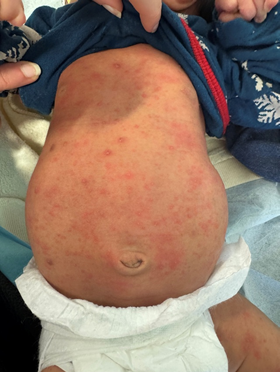
A diagnosis of nodular scabies of the newborn was made clinically. Topical sulfur in a 6% concentration was prescribed for the infant, and permethrin for the rest of the family. Initial improvement was followed by a relapse due to incomplete application to the scalp. After reinforcement of caregiver education and full reapplication, complete resolution occurred within two weeks.
The clinical presentation of scabies is variable. Neonate scabies has unique features, as it typically manifests as nodular eruptions involving the face, neck, scalp, palms, and soles, in contrast to the predominant involvement of the hands, wrists, elbows, and ankles in adults. Excoriations and burrows are rarely seen.4
While scabies diagnosis is primarily clinical, based on history and physical examination, it can pose a significant challenge, particularly for clinicians unfamiliar with its diverse presentations. In our case, the fact that the older sister had a rash compatible with scabies made the diagnosis easier.
The treatment in infants is different than the one from adults, and it should be correctly done, otherwise it’s not effective. Due to its safety, the recommended treatment in newborns is made with topic sulfur.5
Treatment can be challenging, and it’s important to make sure it’s done correctly.5
This case of neonatal scabies with an unusual presentation emphasizes several key points for clinical practice:
1. Maintaining a high index of suspicion for scabies, even in European countries and when facing atypical presentations.
2. The critical need for precise and comprehensive instructions to patients to ensure proper treatment adherence and successful outcomes.
|
| |
| Compliance with ethical standards |
|
Funding: None
|
|
|
Conflict of Interest: None
|
- Iyengar L, Chong AH, Steer AC. Scabies: a clinical update. Med J Aust. 2024 ;221(10):558-63 [CrossRef] [PubMed]
- W. H. Organization., "Scabies.," 2023. [Online]. Available from URL:https://www.who.int/news-room/fact-sheets/detail/scabies. Accessed10 july 2025.
- l-Dabbagh J, Younis R, Ismail N. The current available diagnostic tools and treatments of scabies and scabies variants: An updated narrative review. Medicine (Baltimore). 2023;102(21):e33805. [CrossRef] [PubMed] [PMC free article]
- Boralevi F, Diallo A, Miquel J, Guerin-Moreau M, Bessis D, Chiavérini C, Plantin P, Hubiche T, Maruani A, Lassalle M, Boursault L, Ezzedine K; Groupe de Recherche Clinique en Dermatologie Pédiatrique. Clinical phenotype of scabies by age. Pediatrics. 2014;133(4):e910-6. [CrossRef] [PubMed]
- Seabra Vieira S, Bernardo D, Machado S. Abordagem da Escabiose em Idade Pediátrica: Uma Atualização [Approach to Scabies in Children: An Update]. Acta Med Port. 2025;38(3):175-81 [CrossRef] [PubMed]
|
|
| |
|
DOI:
|
| |
Cite this article as:
Matos B B, Barcelos T. Scabies on a newborn: a different presentation of a neglected not so tropical disease. Infection Child J. 2026;1.
|